

Dental Loupes vs Dental Microscope: Which Should You Buy First?
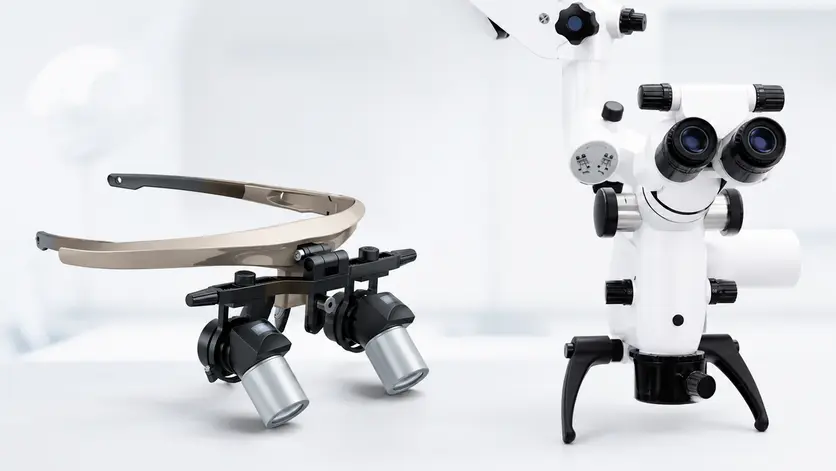
Magnification has quietly become one of the biggest upgrades a dentist can make —
better posture, fewer missed details, and cleaner outcomes. But when it’s time to spend,
most dentists in Malaysia face the same question: do I invest in a pair of
dental loupes or jump straight to a
dental operating microscope?
This dental loupes vs dental microscope guide breaks down the real differences so you can
spend on the right tool for your stage of practice.
Cost & ROI
Ergonomics
Learning curve
Best use cases
What to buy first
Quick Answer
The dental loupes vs dental microscope decision usually comes down to your caseload. For the vast
majority of general dentists, hygienists, and dental students, a quality pair of
2.5×–3.5× loupes is the right first purchase — it’s affordable, portable,
and improves everyday work and posture immediately. A dental microscope makes sense once your
work demands very high magnification and precision — especially in endodontics, microsurgery,
and complex restorative cases. Many established clinics eventually own both: loupes for daily
dentistry and a microscope for specialist procedures.
Dental Loupes vs Dental Microscope: What Each Tool Is For
Loupes and microscopes both magnify the operating field, but they sit at different points on the
precision-versus-flexibility scale. Loupes give you a modest, fixed boost in magnification that you
can wear all day and carry between operatories. A microscope gives you a far wider, adjustable
magnification range with vastly superior lighting — but it stays in one room and asks you to
change how you work.
a specific set of procedures dramatically. The right choice depends on what you do most.
Dental Loupes vs Dental Microscope: Head-to-Head Comparison
| Factor | Dental Loupes | Dental Microscope |
|---|---|---|
| Magnification | Fixed, typically 2.5×–6× | Adjustable zoom, roughly 2×–25×+ |
| Illumination | Optional clip-on LED headlight | Powerful coaxial light, shadow-free along the line of sight |
| Portability | Worn on the face; move freely between rooms | Floor, wall, or ceiling mounted; stays in one operatory |
| Posture / ergonomics | Good, when ordered at the correct working distance | Excellent — encourages an upright, neutral spine |
| Learning curve | Days to a couple of weeks | Weeks to months, plus assistant coordination |
| Documentation | Limited (only with a mounted camera) | Excellent — easy photo and video capture for records and patient education |
| Footprint & setup | Fits in a drawer | Needs dedicated space and stable positioning |
| Relative investment | Entry-level to premium — a fraction of a microscope | A significantly larger capital investment |
For current Malaysian pricing and package options, it’s best to
request a quote rather than rely on a fixed figure.
You can also read our breakdown of
how much dental loupes cost in Malaysia.
Dental Loupes: Strengths & Limits
Loupes are the most common entry point into magnification dentistry, and for good reason. A
well-fitted pair sharpens caries detection, margin checks, and finishing on almost every procedure
you perform — while encouraging a healthier working posture that protects your neck and back over
a long career.
Where loupes shine
- Everyday general dentistry, restorations, hygiene, and exams
- Dentists and students who want an affordable, immediate upgrade
- Practices that need one tool to use across multiple operatories
- Reducing neck and back strain with the correct working distance and declination angle
Where loupes fall short
Magnification is fixed, so you can’t zoom in further for a tricky canal or fracture line. Depth of
field and field of view shrink as magnification climbs, which is why most clinicians settle around
2.5×–3.5×. For the finest endodontic and microsurgical detail, loupes simply can’t match a
microscope’s reach.
Dental Loupes
A correctly specified pair — right magnification, working distance, and a clip-on LED — is the
single best-value upgrade for most clinicians. Explore options on our
dental loupes page, and if you’re unsure which
power to choose, see our guide to
choosing the right magnification.
Dental Microscope: Strengths & Limits
The dental operating microscope is the precision instrument of the profession. By magnifying the field
up to around 25× and pairing it with bright, coaxial illumination, it lets you see into root canals,
spot hairline fractures, and work to a level of detail that’s impossible with the naked eye or loupes
alone. The
American Association of Endodontists
notes that research links magnification with better treatment outcomes, which is one reason microscope
proficiency is now a standard part of endodontic training. It also makes documentation effortless —
valuable for records, referrals, and patient education.
Where a microscope shines
- Endodontics — locating canals, managing isthmuses, and assessing complex anatomy
- Microsurgery and apical procedures requiring the highest precision
- High-end restorative and prosthodontic work where margins are critical
- Clinics that want to capture clinical photos and video for documentation
What to weigh before buying
A microscope is a larger investment, takes dedicated space, and has a real learning curve — you and
your assistant will need time to adapt your workflow and four-handed positioning. As an
expert consensus published in the International Journal of Oral Science
points out, the benefits depend heavily on proper technique and training. It’s most worthwhile when a
meaningful share of your cases genuinely benefits from very high magnification.
Dental Microscope
If your caseload is leaning toward endodontics or fine restorative work, a microscope can change the
quality of your outcomes. See configurations and arrange a demo on our
dental microscopes page, or read our
7-factor guide to choosing a dental microscope in Malaysia.
So, Which Should You Buy First?
There’s no single right answer to the dental loupes vs dental microscope question — it comes down to
your caseload, your budget, and where you want to take your practice. Use this as a quick decision guide:
Start with loupes if…
- You’re a general dentist, hygienist, or student wanting an immediate, affordable upgrade
- You move between operatories and need portability
- Posture and long-term ergonomics are a priority
- You haven’t yet built a caseload that demands very high magnification
Invest in a microscope if…
- You do significant endodontic, microsurgical, or precision restorative work
- You want best-in-class illumination and detail visualisation
- Clinical documentation (photo/video) matters to your practice or referrals
- You have a dedicated operatory and time to adapt your workflow
loupes first to upgrade everyday work, then add a microscope later as their practice specialises. The
two complement each other — loupes for daily dentistry, the microscope for the cases that demand the
most precision.
Not sure which is right for your practice?
Our team can help you match the right magnification solution to your caseload and budget —
and arrange a hands-on demo. Talk to EDI Dental today.
Frequently Asked Questions
Can dental loupes replace a microscope?
Not entirely. Loupes are excellent for everyday dentistry and a modest magnification boost, but
they can’t match a microscope’s high magnification range, coaxial illumination, or fine detail
visualisation for procedures like endodontics and microsurgery.
What loupe magnification is best for beginners?
Most clinicians start with 2.5× or 3.0×, which balances a useful magnification boost with a
comfortable field of view and depth of field. Higher powers offer more detail but a narrower,
less forgiving view that takes practice to use well.
Do I really need a microscope for general dentistry?
For routine general dentistry, no — a good pair of loupes is usually sufficient. A microscope
becomes worthwhile when a meaningful portion of your work involves endodontics, microsurgery, or
very precise restorative procedures.
Is a dental microscope worth it for a small clinic?
It can be, if your case mix justifies it. A microscope is a larger investment and needs dedicated
space, so the return depends on how often you perform procedures that genuinely benefit from high
magnification. If those cases are occasional, quality loupes may serve you better for now.
Dental loupes vs dental microscope — can I use both together?
Yes — many established practices do exactly this. They rely on loupes for day-to-day dentistry
and switch to the microscope for specialist or high-precision cases. The two tools complement each
other rather than compete.