

Ergonomic Dental Loupes: What to Check Before You Buy
A loupe can look comfortable in a showroom and feel quite different at your treatment chair. Try these checks before you commit to a frame, viewing angle or light.
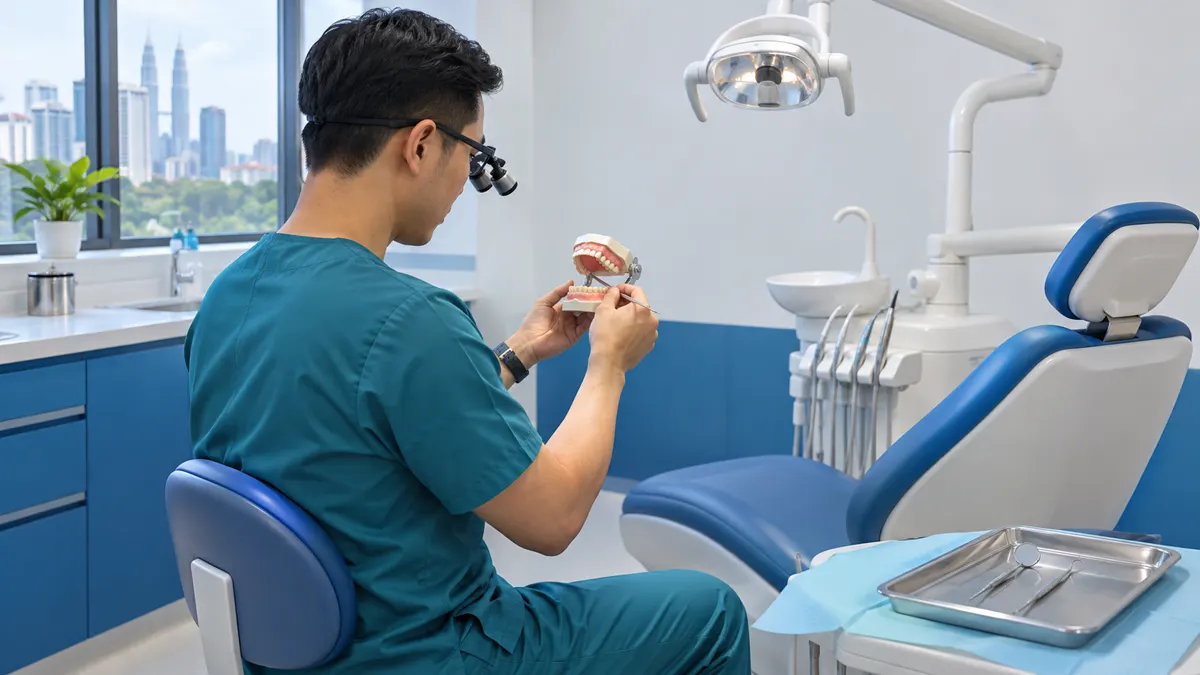
You put on a pair of loupes. The view is clear, the frame looks good—and then you sit down to work. Suddenly, you are leaning towards the patient to find the sweet spot.
That is why buying ergonomic dental loupes is not only about the magnification printed on a product page. This checklist helps Malaysian dentists test fit, working position and lighting before asking for a quotation. It is a practical buying exercise, not a promise that any loupe will prevent pain or change clinical outcomes.
Quick Answer
Test loupes at a treatment chair using your usual sitting height, patient position and working distance. Check whether you can see clearly without repeatedly changing your posture; then compare frame stability, viewing angle, magnification, field of view and light as a complete setup. Ask the supplier how fitting, adjustments and after-sales support work in Malaysia before you choose.
- Bring your real working setup: A chairside trial tells you more about fit than looking across a showroom.
- Start with distance: Measure where your eyes naturally sit relative to the treatment area; do not copy another dentist’s measurement.
- Move, then look again: Check a few of your normal positions rather than judging a single still view.
- Compare the whole system: Frame, lenses, magnification and light affect the experience together.
- Ask about the handover: Confirm what the quotation includes and who handles fitting, adjustments and servicing.
Table of Contents
- How do you test ergonomic dental loupes at your own chair?
- What working distance should you check?
- How do you compare viewing angle and visibility?
- What should you check about the frame and light?
- What should you record during a loupe demo?
- What should a Malaysian clinic ask before requesting a quote?
- Which pair should you shortlist?
- Frequently Asked Questions
How do you test ergonomic dental loupes at your own chair?
Begin with a familiar working position, not a pose chosen for a photograph. Set your stool and patient chair as you normally would, put a safe training model in the position where you work and look through the loupes without stretching to meet the lenses. If a supplier offers only a brief showroom demo, ask whether you can reproduce the height and distance you use in clinic.
Try a few ordinary movements: look at the model, glance at your tray, then return to the field. A pair that looks sharp at one fixed point may be less convenient when your gaze moves. Note whether the frame slips, the image goes out of focus or you keep having to shift the stool. These observations are more useful than deciding that one headline magnification is automatically “better”.
Bring your own prescription details if relevant and tell the fitter whether you usually wear corrective lenses. Ask how the proposed configuration accommodates your eyesight; do not assume that a demonstrator’s frame is built to your prescription. If more than one person will use the loupe, ask about individual fitting instead of treating a single adjustment as universal.
What working distance should you check?
Working distance is the separation between your eyes and the area you are viewing during your usual task. Your body proportions, stool setting, patient position and procedure all affect it. There is no single measurement that fits every Malaysian dentist, and a number borrowed from someone else is a poor substitute for trying the setup at your own chair.
Sit naturally and ask a colleague or fitter to help record the distance while you look at a training model. Then check that the selected loupes focus at that position. If you must move closer to obtain a clear image, ask whether the configuration can be fitted differently rather than compensating with an uncomfortable working position.
Check the distance again after changing the patient-chair height or moving from one typical treatment position to another. A small change in setup can alter what feels usable. The point is not to find a perfect number for every possible procedure; it is to understand the range in which your chosen pair remains practical.
If you are still deciding how much magnification you need, read EDI Dental’s dental loupes magnification guide. This article concentrates on the in-chair fitting decision rather than repeating its power-by-task discussion.
How do you compare viewing angle and visibility?
Compare where you naturally look with where the lenses ask you to look. In a demo, notice whether you can view the treatment area while keeping a comfortable position for your own body. An adjustable viewing angle may be useful, but its actual range and fit depend on the model. Request the manufacturer’s documented options instead of relying on a generic claim about the “ideal” angle.
Look at more than the centre of the image. How much of your work area can you see without moving your head? Can you refocus after a normal movement? Does the view still make sense when a light is added? These questions help you compare field of view and practical handling without making an unsupported claim that one configuration suits every specialty.
Try the loupe for a realistic stretch of a demonstration if that is available. A momentary clear image is not the same as understanding how the setup behaves when you alternate between the working field, instruments and conversation. If your clinic performs different tasks, tell the fitter which one you use most often and which one challenges your current setup.
What should you check about the frame and light?
The frame should remain stable when you move between your usual positions. Check how it rests on your nose and ears, whether it interferes with your mask or face protection, and whether you can adjust it without losing the view. A heavier setup is not automatically unusable, and a lighter one is not automatically comfortable: balance and fit matter.
If you plan to use an attached light, test the loupes with the light fitted—not as a separate accessory on the table. Ask to see the intended battery, cable routing, charging method and cleaning instructions. Confirm which items are included in the actual quotation. Do not assume the demo light, spare battery or accessories are part of a basic package.
Also ask how the frame will be handled if it needs an adjustment after delivery. A configuration that fits on demo day may still need attention once you have used it in your own clinic. Obtain the supplier’s current after-sales terms in writing instead of relying on a general warranty slogan.
Do not judge a loupe from one specification
Magnification, field of view, frame fit, working distance and light interact. Change one thing at a time during a demo and record what you noticed. That gives you a fairer comparison than switching frames, lights and stool height all at once.
What should you record during a loupe demo?
Use the same short test for every shortlisted pair. The table below is a decision aid, not a product ranking or clinical specification. Keep your notes practical enough that you can revisit them when comparing written quotations.
| Check | Try this at the chair | Record before you decide |
|---|---|---|
| Working position | Set your usual stool and patient-chair height. | Could you see clearly without repeatedly moving closer? |
| Viewing range | Look at the training model, then tray, then model again. | Was it easy to find the working field each time? |
| Frame fit | Move through normal seated positions with your usual mask or face protection. | Did the frame stay put, and what needed adjustment? |
| Light | Try the exact light configuration being quoted. | What is included, and where do the battery and cable sit? |
| Handover | Ask how fitting and later adjustments will work. | Who provides support, where, and under which written terms? |
A table cannot decide for you, but it prevents an attractive brochure feature from crowding out the details you will notice every working day. If one pair suits your primary task but not a less common task, say so in your notes and ask what alternatives the fitter can demonstrate. It is fine to keep a simpler setup if it genuinely fits your needs.
What should a Malaysian clinic ask before requesting a quote?
Tell the supplier your main procedures, approximate working setup, prescription needs, preferred frame and whether you expect to use a light. Ask which configuration was actually demonstrated and whether the quoted item matches it. Two prices cannot be compared fairly if one includes a light, fitting or accessories and the other does not.
For a Malaysian clinic, also ask who will arrange delivery, initial fitting, adjustments and support after purchase. Request the current terms for the exact model and package. Availability and quotations can change, so this article does not state an EDI Dental selling price or a guaranteed service arrangement.
- Model and configuration: Confirm frame, magnification, lens options and any prescription arrangement.
- Light and accessories: Identify the battery, charger and other included or optional items.
- Fitting: Ask how your working distance and viewing position are recorded and adjusted.
- After-sales: Obtain written support, servicing and warranty terms for the quoted package.
- Budget: Share a sensible range so the supplier can explain trade-offs without claiming that the most expensive option is always necessary.
EDI Dental lists dental loupes available for Malaysian clinics. Use that page for the current range and ask for a quotation on the precise setup you tried. For the separate budget decision, see how much dental loupes cost in Malaysia; verify any current figures in a written quote rather than treating an article as a price list.
Which pair should you shortlist?
Shortlist the pair that you can use clearly in your own working position, with a frame and light setup you have actually tested and a quotation you understand. For ergonomic dental loupes, a careful fit check beats an impressive specification you have not tried. If your current simpler pair already works well for your typical tasks, you may not need a more elaborate configuration.
Use the demo table, compare like-for-like quotations and ask about adjustments before paying. That is a more useful decision than choosing from magnification alone.
Want to compare loupe fit for your clinic?
Tell EDI Dental what procedures you do, how your treatment room is set up, whether you wear prescription lenses and the budget range you have in mind.
Ask which loupe configurations can be demonstrated and request a current Malaysian quotation with the exact included items and support terms.
Still comparing equipment? Start with the EDI Dental loupes range, then use the loupes versus microscope comparison if you are choosing between magnification systems rather than between loupe frames.
Frequently Asked Questions
How do I know whether ergonomic dental loupes fit me?
Try them at a treatment chair with your usual stool height, patient position and working posture. Check whether you can see your work area clearly without repeatedly shifting yourself towards the focal point. Ask the fitter to record your working distance and to explain which adjustments are possible for the exact configuration.
Is there one ideal working distance for dental loupes?
No single distance suits every dentist or every clinic setup. Your height, stool, patient position and typical tasks all influence the distance at which you work comfortably. Measure your own position during a chairside demo and confirm that the proposed lenses are configured for it rather than copying a colleague’s measurement.
Should I choose a stronger magnification for better ergonomics?
More magnification is not automatically a better fit. Compare the working distance, visible area and handling for your actual tasks before deciding. If you are choosing between powers, use a hands-on trial and ask the supplier to explain the documented options for the specific models available.
Can I test loupes while wearing my usual mask or face protection?
Yes, a realistic demonstration should account for the equipment you normally wear if the supplier can accommodate it. Check whether the frame remains stable and whether the view changes when you move. Tell the fitter about prescription needs or other eyewear so the proposed configuration matches your working setup.
What should I ask about a dental loupe light?
Try the light attached to the loupes you are considering. Ask what battery, charger and accessories come with the quoted configuration, how the cable is routed and what the current cleaning and servicing instructions say. Do not assume a demo accessory is included unless the written quotation lists it.
Do ergonomic loupes prevent neck pain?
No product should be treated as a guarantee against pain or injury. A careful fitting exercise can help you assess whether a setup lets you work in your usual position without repeatedly chasing the view. If you have persistent discomfort, seek appropriate professional assessment rather than relying on equipment alone.
Where can I buy ergonomic dental loupes in Malaysia?
EDI Dental lists dental loupes for Malaysian clinics on its website. Ask the team which current configurations can be demonstrated and request a written quotation for the exact frame, lenses, light and support terms you need. Compare the trial and package details, not just a headline price.