

The Silent Career Killer: How Forward Head Posture Ends Dental Careers Early (And How to Fix It)
Why a small change in dental microscope positioning can make a major difference to how comfortably you work every day.
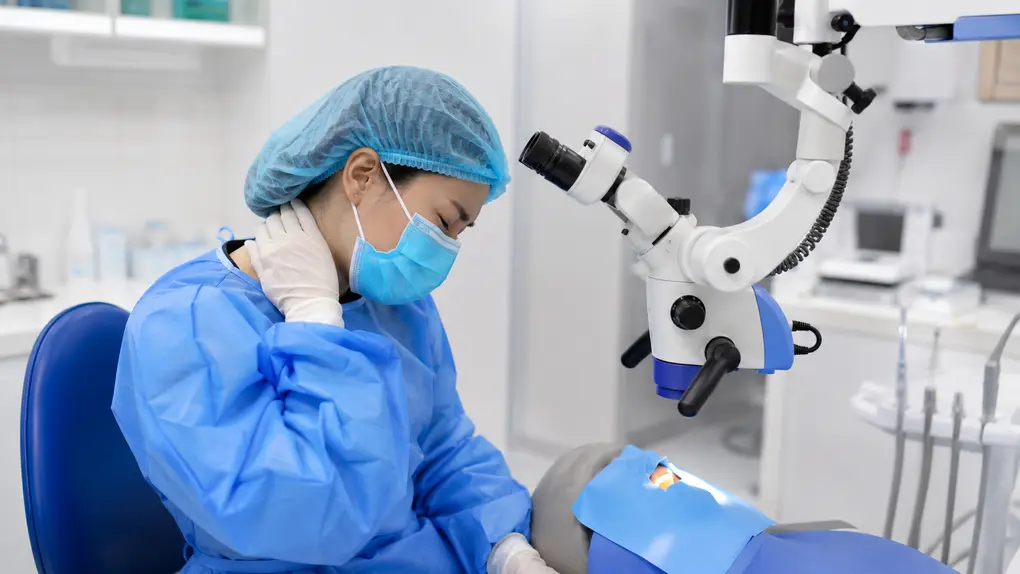
Dentistry demands precision, but that precision often comes at a physical cost. Repeatedly leaning towards a patient or moving your head forward to reach microscope eyepieces can place additional strain on the neck, shoulders and back over thousands of clinical hours.
Quick Answer
Forward head posture happens when the head moves forward from a more neutral position above the shoulders. In dentistry, this may occur when clinicians repeatedly lean towards the treatment field or when microscope eyepieces are positioned too far forward or too low.
A properly configured dental microscope can support a more upright working posture. For some setups, a 30° binocular extender can reposition the eyepieces closer to the operator, reducing the need to move the head towards the microscope.
Key Takeaways
- Musculoskeletal problems are common among dental professionals.
- Sustained forward head posture can increase mechanical loading on the neck.
- A dental microscope should be positioned around the dentist—not force the dentist to adapt to the microscope.
- A binocular extender can change the viewing position without replacing the main microscope body.
- ZUMAX offers a 30° binocular extender and beam splitter for compatible microscope configurations.
- Compatibility should always be confirmed for the exact microscope model before ordering.
Table of Contents
Why Forward Head Posture Matters in Dentistry
Dentists spend long periods performing precise work within a relatively small treatment area. Even with a good stool and correctly positioned patient, poor visual access can gradually pull the clinician away from a neutral working posture.
A systematic review and meta-analysis involving dental healthcare providers reported a high prevalence of work-related musculoskeletal disorders, with the neck, back and shoulders among commonly affected areas.
The issue is not simply whether you feel uncomfortable during one procedure.
If your equipment repeatedly encourages you to lean forward, tilt your neck or round your shoulders, small positioning problems can become part of your everyday working habit.
The Hidden Load on Your Neck
Your head does not physically become heavier when you tilt it forward, but the mechanical demand placed on the cervical spine increases as the head moves further away from a neutral position.
One frequently cited biomechanical model estimated the effective load on the cervical spine at different angles of forward head flexion:
| Forward Head Angle | Estimated Cervical Load |
|---|---|
| Neutral position | Approximately 10–12 lb |
| 15° forward | Approximately 27 lb |
| 30° forward | Approximately 40 lb |
| 45° forward | Approximately 49 lb |
| 60° forward | Approximately 60 lb |
These figures are biomechanical estimates rather than the actual weight of the head, but they demonstrate why prolonged forward flexion can matter.
Can Your Dental Microscope Setup Cause Poor Posture?
A dental operating microscope can support better ergonomics because it allows the clinician to see the treatment area without bringing the face close to the patient.
However, the benefits depend heavily on how the microscope is configured.
If the binocular eyepieces stop several centimetres away from your natural eye position, you may gradually move your head towards them.
- Your chin starts moving forward.
- Your neck begins to flex.
- Your shoulders may round.
- You may start adjusting your entire body around the microscope.
Instead of the microscope supporting your posture, your posture begins adapting to the microscope.
This is where an accessory such as a binocular extender can be useful.
What Is the ZUMAX 30° Binocular Extender?
The ZUMAX 30° Binocular Extender and Beam Splitter is an optional microscope accessory designed to change the position and viewing angle of the binocular head.
By adding additional structural distance between the microscope body and the binoculars, the extender can bring the eyepieces closer to the operator’s natural viewing position.
Simple Principle
Bring the microscope to your eyes—not your head to the microscope
Without the right configuration, the dentist may move forward towards the microscope.
With an appropriately positioned binocular extender, the eyepieces can be brought closer towards the dentist instead.
EDI Dental currently lists a 30° binocular extender and beam splitter among the optional accessories available for selected ZUMAX microscope configurations.
Key Benefits of a Microscope Binocular Extender
1. Supports a More Neutral Working Posture
The main purpose of the extender is positioning.
By moving the binocular eyepieces closer to the clinician, it may reduce the need to project the head forward simply to reach the oculars.
This can help support a more neutral relationship between the head, neck, shoulders and upper body during microscope-assisted treatment.
2. Adds a 30° Optical Extension
The additional 30° positioning provides another adjustment point between the microscope and the clinician.
This can be particularly useful when the standard binocular position does not naturally align with the dentist’s eye level or preferred working posture.
3. Helps Adapt the Microscope to the Dentist
Every dentist is different.
- Different body heights
- Different sitting positions
- Different arm lengths
- Different patient-chair heights
- Different operatory layouts
- Different preferred working distances
Adding another adjustment point can make it easier to configure the microscope around the clinician rather than forcing the clinician into a fixed position.
4. Does Not Require Replacing the Main Microscope
For compatible systems, the extender can be added as an accessory without replacing the primary microscope body.
This makes it particularly relevant for clinics that are satisfied with their existing microscope optics but want to improve binocular positioning.
5. Can Improve Day-to-Day Workflow Comfort
The benefit of ergonomic equipment is not necessarily something dramatic that happens during one procedure.
It is the cumulative difference of being able to work in a better position repeatedly throughout the day.
Standard Setup vs Binocular Extender
| Standard Microscope Setup | With an Appropriate Extender |
|---|---|
| Clinician may need to move towards the eyepieces | Eyepieces can be positioned closer to the clinician |
| May encourage forward head positioning if poorly configured | Can provide additional positioning flexibility |
| Limited adjustment between microscope body and binoculars | Adds another ergonomic adjustment point |
| Dentist may adapt posture around the equipment | Equipment can be adapted more closely to the dentist |
Does the ZUMAX Extender Fit Other Microscope Brands?
The ZUMAX binocular extender has also been listed by specialist equipment suppliers as compatible with selected microscope systems from other manufacturers, including ZEISS and Seiler.
However, microscope interfaces can differ between models and generations.
If you are using a non-ZUMAX microscope, provide the exact microscope brand and model when requesting compatibility confirmation.
What to Check Before Installing a Microscope Extender
An extender alone cannot correct every ergonomic problem. Your entire working setup should be considered together.
- Set the dentist stool to a comfortable working height.
- Position the patient appropriately for the procedure.
- Adjust the microscope working distance.
- Set the binocular inclination.
- Adjust interpupillary distance correctly.
- Bring the microscope towards your natural eye position.
- Check that your shoulders remain relaxed.
- Check whether your head remains comfortably above your shoulders.
- Confirm the extender is compatible with your microscope configuration.
Ergonomic Check
Look at your posture before looking through the microscope
Sit naturally first. Then bring the microscope and binoculars towards your eyes.
If you immediately need to move your head or upper body forward to reach the eyepieces, the microscope configuration may need further adjustment.
Who Should Consider a Binocular Extender?
A microscope extender may be worth considering if:
- You regularly find yourself moving your head forward to reach the oculars.
- You cannot comfortably maintain an upright working position with your current microscope setup.
- Your standard binocular position feels too far away.
- You perform long microscope-assisted procedures.
- You want additional ergonomic adjustment without replacing your microscope.
- You are setting up a microscope for different clinicians with different body heights.
Because ergonomics are highly individual, the best way to determine whether an extender is useful is to evaluate your actual working position rather than choosing solely from specifications.
Dental Microscope Ergonomics: The Bigger Picture
A binocular extender is only one part of an ergonomic microscope setup.
For the best working position, consider the complete system:
| Adjustment | What It Affects |
|---|---|
| Dentist stool | Hip position, back support and working height |
| Patient chair | Access to the treatment area |
| Working distance | Distance between objective lens and treatment field |
| Binocular angle | Head and eye position |
| Binocular extender | Distance and angle between clinician and microscope |
| Microscope arm | Positioning and movement during treatment |
The objective is not to create one theoretically perfect posture and remain completely static.
Instead, the goal is to minimise unnecessary bending and allow the equipment to support a comfortable, sustainable working position.
Protect Your Posture Before Discomfort Becomes the Normal Way You Work
Dentists often spend heavily on better optics, higher magnification, cameras and advanced treatment equipment.
But one of the most valuable upgrades may simply be getting the microscope into the right position.
If your current setup forces you to move towards the eyepieces, a ZUMAX 30° binocular extender may provide the additional positioning needed to create a more ergonomic working arrangement.
Is your microscope forcing you to lean forward?
Speak with the EDI Dental team about the ZUMAX 30° binocular extender, compatibility with your microscope and available configuration options.
Protect your posture, protect your spine, and make your microscope work around you—not the other way around.
You can also explore the
ZUMAX dental microscope range
available from EDI Dental.
Frequently Asked Questions
What is forward head posture in dentistry?
Forward head posture occurs when the head moves forward from a more neutral position above the shoulders. In dentistry, this can happen when the clinician leans towards the patient or moves forward to reach microscope eyepieces.
Can a dental microscope improve ergonomics?
A correctly configured dental microscope may support a more upright working position by allowing the clinician to view the treatment area through magnification rather than repeatedly leaning closer to the patient. The ergonomic benefit depends on correct microscope, patient and operator positioning.
What does a microscope binocular extender do?
A binocular extender changes the distance and position between the microscope body and the eyepieces. This can allow the oculars to be positioned closer to the clinician’s natural eye position.
What angle is the ZUMAX microscope extender?
The ZUMAX binocular extender discussed in this article provides a 30° extension and is available for compatible microscope configurations.
Can the ZUMAX extender fit ZEISS or Seiler microscopes?
Specialist equipment suppliers list the ZUMAX extender as compatible with selected ZEISS and Seiler microscope systems. Compatibility should be confirmed using the exact microscope brand and model before ordering.
Will a microscope extender cure neck pain?
No. A microscope extender is an ergonomic positioning accessory and should not be treated as a medical treatment. Its purpose is to provide additional positioning flexibility that may help the clinician maintain a more comfortable working posture.
Do I need to replace my microscope to use an extender?
Not necessarily. On compatible microscope systems, the extender can be installed as an accessory without replacing the main microscope body. Confirm compatibility before purchasing.
How do I know whether I need a microscope extender?
Sit in your normal comfortable working position and bring the microscope towards your eyes. If you repeatedly need to move your head or upper body forward to reach the eyepieces even after normal microscope adjustment, an extender may provide useful additional positioning flexibility.