

Types of Dental Mirrors: Which Should Your Clinic Choose?
A basic mouth mirror, a fog-resistant option or a mirror that connects to suction? The useful choice depends on the job you need it to do.
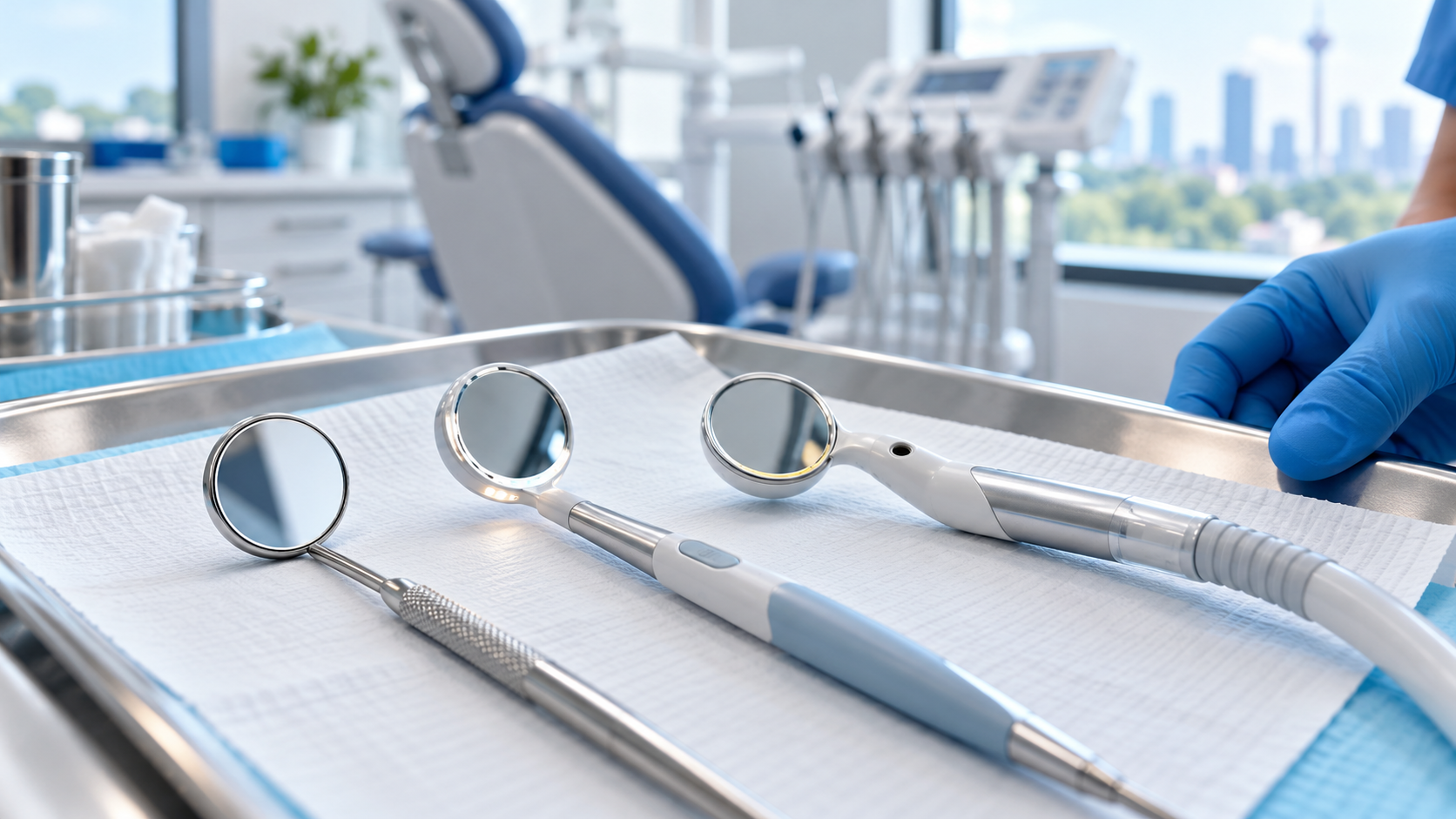
Your dentist asks for a mirror. Which one do you hand over: the familiar round one, the one with a light, or the one connected to suction? They may look like variations of the same tool, but the extras matter when the task changes.
Here is a practical way to compare the types of dental mirrors you might consider for a Malaysian clinic. We will separate everyday viewing from fog management, suction-assisted work and flexible specialised mirrors, then show you what to ask before ordering.
Quick Answer
Start with a conventional mouth mirror for routine viewing and cheek or tongue retraction. Consider a fog-control or illuminated mirror when visibility and lighting are the recurring problem, a suction mirror when you need a mirror paired with suction, or a flexible specialist mirror when access is the challenge. Check the actual product's accessories, connection requirements and reprocessing instructions before treating any two mirrors as interchangeable.
- A conventional mirror is a sensible starting point; extra functions are not automatically better for every procedure.
- Fog-control, lighting, suction and flexible working ends address different practical problems.
- Ask about replacement mirror heads or tips, handpiece or hose requirements, and the manufacturer's care instructions for the exact model.
- EDI Dental lists several mirror options; compare their stated functions rather than assuming they share specifications.
Table of Contents
Types of Dental Mirrors: The Main Differences
The names are easy to mix up. A mouth mirror is the familiar instrument for indirect viewing and soft-tissue retraction. Other products add a function: managing moisture on the reflective surface, putting light near the viewing area, combining the mirror with suction, or offering a bendable working end. Those are different purchasing decisions, not a simple good-to-best ladder.
1. Conventional mouth mirrors
For a straightforward examination, a standard round mirror often does the job. You use it to look at surfaces that are awkward to view directly and to move the cheek or tongue when needed. If that describes most of your use, start by checking mirror size, handle feel, replacement arrangement and the manufacturer's care instructions rather than paying for functions you rarely use.
EDI Dental lists a ZIRC mirror as an existing product option. Its product listing describes a package of assorted colours and its own mirror features; check the current listing or request product information for the exact configuration before ordering. This article does not assume that every standard mirror has the same coating, brightness or cleaning limits.
2. Fog-control and illuminated mirrors
Ever had to interrupt your view because the reflective surface misted over? A fog-control mirror aims to make that less disruptive. Some options add a light near the mirror as well, but a light and a fog-control mechanism are not the same thing. Ask how each feature works on the particular device you are comparing.
For example, EDI Dental's Royva LED fog-free mirror listing describes built-in LED lighting, a hydrophobic mirror and a dual-airflow arrangement. It also lists connecting tubing, a three-way-syringe adapter and replacement mirrors. That means you should check the connection and included components against your own treatment-room setup; do not assume it works as a stand-alone conventional mirror without its accessories.
3. Suction-assisted mirrors
A suction mirror combines a viewing surface with suction in one instrument. That can be worth considering when the practical bottleneck is managing a mirror and suction at the same time. The relevant question is not whether it replaces every other mirror, but whether its connection, tip and workflow make sense for the procedures in which you would use it.
EDI Dental's Royva suction mirror listing describes a mirror-and-saliva-suction function. The listed set includes a handle, connecting hoses, an adapter and disposable mirrors. Before buying, confirm what connects to your existing suction setup and what ongoing replacement pieces you will need. Do not infer a universal fit from the product name.
4. Flexible specialist mirrors
There is also a different kind of access question: what if a fixed mirror shape is awkward for a particular working area? A flexible working end may be useful to evaluate for specialist tasks. That does not turn it into a replacement for every routine mouth mirror.
EDI Dental's Royva Fleximirror kit listing describes a bendable working end and a set with multiple tip sizes. The listing positions it for root-canal work; ask for the current product information and handling instructions if that is the use you have in mind. The best choice depends on the access problem, not a generic claim that flexible mirrors improve clinical outcomes.
Which Mirror Solves Which Problem?
Use the table to make a shortlist, not to select a product by feature count. It describes functions, not a test of one brand against another.
| Mirror type | When to consider it | What to verify |
|---|---|---|
| Conventional mouth mirror | Routine indirect viewing and retraction | Size, handling, replacement parts and care instructions |
| Fog-control or illuminated mirror | When misting or local illumination is a repeated workflow issue | How the feature operates, connections and included refills |
| Suction-assisted mirror | When combining viewing and suction may simplify a particular task | Hose/adapter compatibility and disposable or replacement components |
| Flexible specialist mirror | When the shape of the working end matters for access | Tip options, handling and intended application |
Questions to Ask Before Buying
What problem are you actually trying to solve?
Start with the moment your present mirror slows you down. Is it ordinary indirect viewing? Does mist interrupt your view? Are you trying to coordinate a mirror with suction? Or is access to a working area the issue? A specific problem gives you a better buying brief than “we need a better mirror”.
What else needs to be connected or replaced?
A standard mirror and a mirror with tubing are very different orders. Ask what comes in the set, whether a compatible adapter or handle is included, and how to obtain refills or replacement mirror pieces. If a listing mentions a three-way syringe, hose or suction connection, confirm it against the fittings in your treatment room rather than assuming compatibility.
How will your clinic look after it?
Do not generalise cleaning, sterilisation or reuse instructions from one mirror to another. Some listed products include disposable parts while other components have their own care requirements. Request the manufacturer's current instructions for the exact handle, tip, mirror head and accessory, and have your clinic check them against its own infection-control procedures.
Does the quotation cover the whole setup?
A headline product name may not tell you which handle, adapter, tubing or replacement mirrors are supplied. Ask for a written breakdown of the configuration, consumables, availability and current Malaysian quotation. This makes it easier to compare like with like, without assuming that a lower initial price means a lower ongoing cost.
Putting Together a Practical Clinic Selection
For a Malaysian practice, there is no need to switch every room to one “premium” mirror simply because it has more features. Begin with a reliable everyday option that fits the work your clinicians do. Add a fog-control, suction-assisted or flexible option where a repeated workflow problem makes that function worth evaluating. The right mix may differ between rooms and practitioners.
When you enquire, tell the supplier which procedures the mirror is for, what equipment is already in your treatment room and whether you need refills or spare parts. If you are considering a connection-dependent mirror, a photo or description of the existing fitting can help you ask a more precise compatibility question. Do not treat this article as a guarantee that any product fits a particular system.
A short checklist for your enquiry
- State the task: routine viewing, fog management, suction-assisted viewing or access to a difficult working area.
- Ask for the exact model, set contents, replacement parts and manufacturer's care instructions.
- For connected options, describe your existing syringe or suction fittings and ask about compatibility.
- Request a current Malaysian quotation for the complete configuration, not just the mirror head.
The Right Mirror Depends on the Task
There are several types of dental mirrors, but a longer feature list is not a shortcut to the right purchase. A conventional mirror may cover your everyday needs. Fog-control or lighting, suction and flexible tips deserve a closer look when they solve a real, repeated problem in your clinic. Match the function to the task, then verify the actual set, fittings and care instructions.
Not sure which mirror belongs in your clinic?
Tell EDI Dental what procedures you use it for, your treatment-room setup, the connection or visibility problem you want to solve, and your budget.
Ask us to compare the listed options and provide a current Malaysian quotation for the configuration you need. Product availability and compatibility should be confirmed before ordering.
Ask EDI Dental About Dental MirrorsExplore EDI Dental's ZIRC mirror, Royva LED fog-free mirror, Royva suction mirror and Royva Fleximirror kit. These are product listings, not claims that any one model suits every procedure.
Frequently Asked Questions
What are the main types of dental mirrors?
A conventional mouth mirror is the starting point for routine indirect viewing and retraction. Other options add fog management, illumination, suction or a flexible working end. Compare the actual device and intended task, because those features are not interchangeable.
What is the difference between a dental mouth mirror and a suction mirror?
A conventional mouth mirror helps you view areas indirectly and retract soft tissue. A suction mirror adds a suction function to the viewing instrument. Check the suction connection and replacement components before assuming it will fit your existing setup.
Do I need a fog-free dental mirror?
Not necessarily. If a conventional mirror works well in your clinic, it may be enough. If misting repeatedly interrupts your view, ask how a specific fog-control model works and what accessories or refills it needs.
Is an LED dental mirror the same as a fog-free mirror?
No. LED describes a lighting feature, while fog-control refers to managing moisture on the reflective surface. A particular model may offer both; check its product information rather than assuming one feature implies the other.
Can a suction mirror replace a regular mouth mirror?
It may be useful for selected tasks, but it need not replace a simple mirror for routine work. Consider the suction connection, handling and replacement parts for the way your clinic actually works. Ask the supplier to confirm the exact configuration.
Are all dental mirrors reusable or autoclavable?
No single care rule applies to every mirror or component. Some listed sets include disposable mirror pieces, and a handle or accessory may have different instructions from its tip. Follow the manufacturer's current instructions for the exact model and your clinic's infection-control procedures.
Where can I buy dental mirrors in Malaysia?
EDI Dental lists ZIRC and Royva mirror options for Malaysian clinics, including conventional, fog-control, suction-assisted and flexible products. Review the linked listings and ask EDI Dental to confirm availability, set contents, compatibility and a current Malaysian quotation before ordering.